

Search is entering a phase where understanding matters more than matching. A few years ago, ranking well often depended on how effectively a page targeted a keyword and accumulated authority signals such as backlinks. Today, AI-powered search systems are increasingly designed to interpret entities, relationships, intent, and context before generating an answer. This change affects how content should be written, organized, and technically described.
Schema markup sits at the center of this transition. Many businesses still think of structured data as a way to obtain star ratings, FAQ enhancements, or other visual search features. That view is outdated. In the era of Google AI Overviews, Gemini, ChatGPT, Perplexity, and similar conversational search tools, schema is becoming a semantic infrastructure layer that helps machines understand what a website represents and how its information connects together.
The difference between a website that is merely indexed and one that is consistently understood by AI systems often comes down to entity clarity. When search engines can clearly identify the organization behind the content, the expertise of the author, the service being discussed, and the relationship between those elements, the content becomes easier to retrieve, summarize, and potentially cite in AI-generated responses.
This is why modern schema strategy should focus less on adding more markup and more on building a coherent knowledge structure around your brand and content.
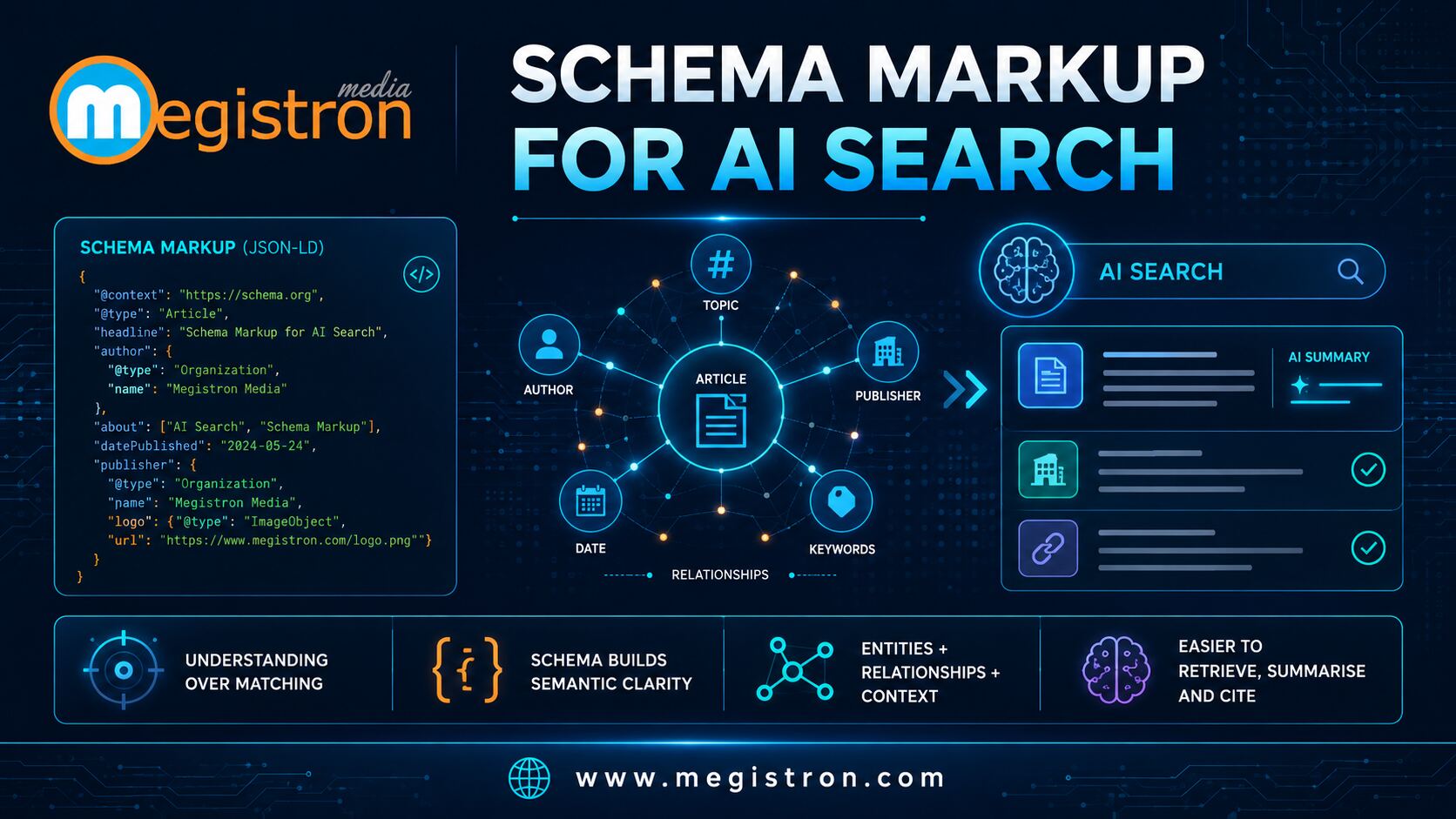
AI Search Is Changing the Way Content Is Interpreted
Imagine a user asking:
“Which schema markup strategy should a local digital marketing agency use for AI search visibility?”
An AI system must determine that the page is about schema markup, that the business is a digital marketing agency, that it operates in a specific location, and that the advice is being provided by a credible source. If those signals are unclear, the system may retrieve another source whose entities are easier to interpret, even if the written content is similar.
This is the key reason schema matters in AI search. It reduces the amount of guessing that search engines must do. Instead of inferring relationships from scattered text, structured data explicitly defines who is speaking, what is being discussed, and how those entities are connected.
The websites that perform best in AI-driven discovery are often those that present information in a way that resembles a well-organized database, not just a collection of webpages.
Why Generic Schema Implementations Fail
Most modern CMS platforms can generate schema automatically, but automatic does not mean strategic. A typical plugin may add WebPage, Article, and Organization markup without understanding the actual purpose of the page.
The result is technically valid but semantically weak. The article exists, the organization exists, but the connection between them is often superficial. The author may be represented only as plain text, the service being discussed may not be defined as an entity, and the organization may be duplicated across multiple schema blocks with inconsistent identifiers.
For AI systems, these disconnected signals provide limited value. Structured data becomes powerful only when it forms a consistent network of entities that reinforce one another across the entire website.
The Most Important Principle: Entity Consistency
If there is one principle that matters more than any specific schema type, it is entity consistency.
Your organization should have a single, stable identity across:
- the website,
- schema markup,
- Google Business Profile,
- social media profiles,
- business directories,
- and any authoritative external references.
If the website uses OutsourceSEM, LinkedIn uses Outsource SEM Digital, and local directories use OutsourceSEM Agency, search engines receive conflicting signals about whether these references represent the same entity.
AI systems build confidence through repetition and consistency. Every variation introduces ambiguity. A strong schema strategy therefore begins with standardizing the business identity before adding additional structured data layers.
Building a Connected Entity Architecture

A high-quality AI-search implementation treats the Organization as the root entity. Every important author, service, article, product, or location page should connect back to that same organization through stable @id references.
This creates a semantic structure where:
- the Organization publishes the Article,
- the Person writes the Article,
- the Organization provides the Service,
- and the Article supports or explains that Service.
When these relationships are modeled consistently, search engines can understand not only individual pages but also the topical expertise of the entire domain.
This is particularly valuable for agencies, consultants, SaaS companies, and publishers that produce large amounts of educational content related to their commercial offerings.
Author Entities Matter More Than Most Businesses Realize
One of the clearest trends in AI search is the growing importance of identifiable expertise. Anonymous content is harder to evaluate. A named author with a defined professional role provides a much stronger trust signal.
Instead of listing an author as plain text, create a reusable Person entity that includes the individual’s name, role, expertise area, and relationship to the organization.
The benefit is cumulative. When multiple articles reference the same author entity, search engines can begin associating that person with specific topics such as technical SEO, structured data, local SEO, ecommerce optimization, or analytics. Over time, this strengthens the semantic connection between the author, the organization, and the subject matter.
For AI-generated answers, understanding who has demonstrated expertise on a topic is becoming increasingly important.
Structuring Articles for AI Extraction
A good schema alone is no substitute for poor structuring. AI systems often pull excerpts of content rather than full articles. The writing needs to be structured in a way to enable this.
The most powerful pattern is to start your main sections with an independent answer statement and then explain.
Like this:
Entity consistency is the key schema signal for AI search, as it enables retrieval systems to associate your organization, authors, services and supporting content into one coherent knowledge structure.
This sentence can be used by AI systems independently as an excerpt without any context loss.
Headings need to be descriptive and question-oriented. Headings like Why Entity Consistency Matters say way more about the semantic nature of the content than Advanced Considerations.
The Power of @graph
Most schema implementations include separated JSON-LD blocks scattered throughout the page. This approach may work, but it doesn’t communicate relationships between the entities.
@graph allows defining multiple entities in one interconnected structure. It is helpful since AI systems are not just interested in entities themselves, but also in their relationships.
With @graph you can tell AI that a certain author belongs to a certain organization, this organization offers a certain service and this article talks about that service within the scope of education. It creates a much more complex semantic signal than isolated schema objects without any relationships.
For the businesses producing topical content clusters, @graph is one of the most effective ways to increase topical authority and entity consistency.
Service Pages: Usually The Big Missed Opportunity
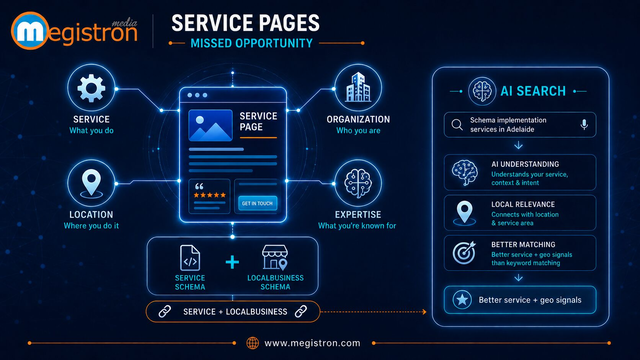
The biggest focus in schema discussions is always on blog posts, while service pages are usually way more commercial.
Your typical service page includes a lot of convincing copy, testimonials and call-to-actions, but still there can be some difficulties with the following points:
- which exact service the page talks about;
- what organization offers this service;
- where it is available;
- how it is connected with the expertise of the organization.
With the help of the service schema, one can easily describe the relations discussed above. Thus, for local companies the combination of Service and LocalBusiness schema forms a great link between what company does and where the activity takes place.
This becomes more relevant when considering the request like such:
“Who provides schema implementation services in Adelaide?”
AI systems processing this kind of request will rely more on these geographical and service signals than on keyword matching on the web page.
Example: Structuring Schema for AI
Let’s take a digital marketing company providing educational materials for technical search engine optimization and schema implementation. The average schema markup would include Article and Organization schemas only.
But with an AI-driven schema strategy, you’ll create a stronger relationship between these entities. The article will mention the author as a Person schema, publisher as Organization and topic of the article as a Service schema.
Here is a clear semantic relationship:
- The organization provides the schema implementation services.
- Expert Author publishes content about the structured data.
- The article talks about the topic related to the services of the organization.
In this case, AI systems will not treat the article as an isolated page, but as a part of the larger knowledge structure. Such interconnections help increase topical authority as it makes the connections between content, expertise and business purpose obvious.
The point here is that schema doesn’t create authority by itself. It helps the search engines understand the existing authority through content, real expertise and consistent brand information.
LocalBusiness Schema Requires More Than An Address
Another mistake is using LocalBusiness schema as a container of contact information. But this schema is much more dependent on the consistency throughout the whole web.
Such properties as Business Name, Address, Phone Number, Opening Hours, Website URL should match in all major citations sources. Minor inconsistencies might ruin the entity’s confidence.
For AI search, local entity consistency is especially important because of conversational queries combining information from maps, business profiles, directories and website content at once. Schema helps to make sure that your website adds your own, consistent version of this information.
Measuring If Your Schema Helps With AI Visibility
As schema is not an AI ranking factor, the measurement criteria should be different from the usual SEO parameters.
Instead of focusing on rich snippets alone, check if
- conversational long-tail query impressions increased,
- your brand attribution became more consistent,
- authors are mentioned by their correct names,
- AI summaries correctly talk about your services,
- The correct business entity is identified by the search engines.
One of the practical tests is to ask multiple AI search tools to make questions on your expertise and see if they identify your organization, authors and services correctly. Misidentifications can be seen as the symptoms of the low quality semantic signals on your website.
The Future Of Schema Is Semantic Clarity
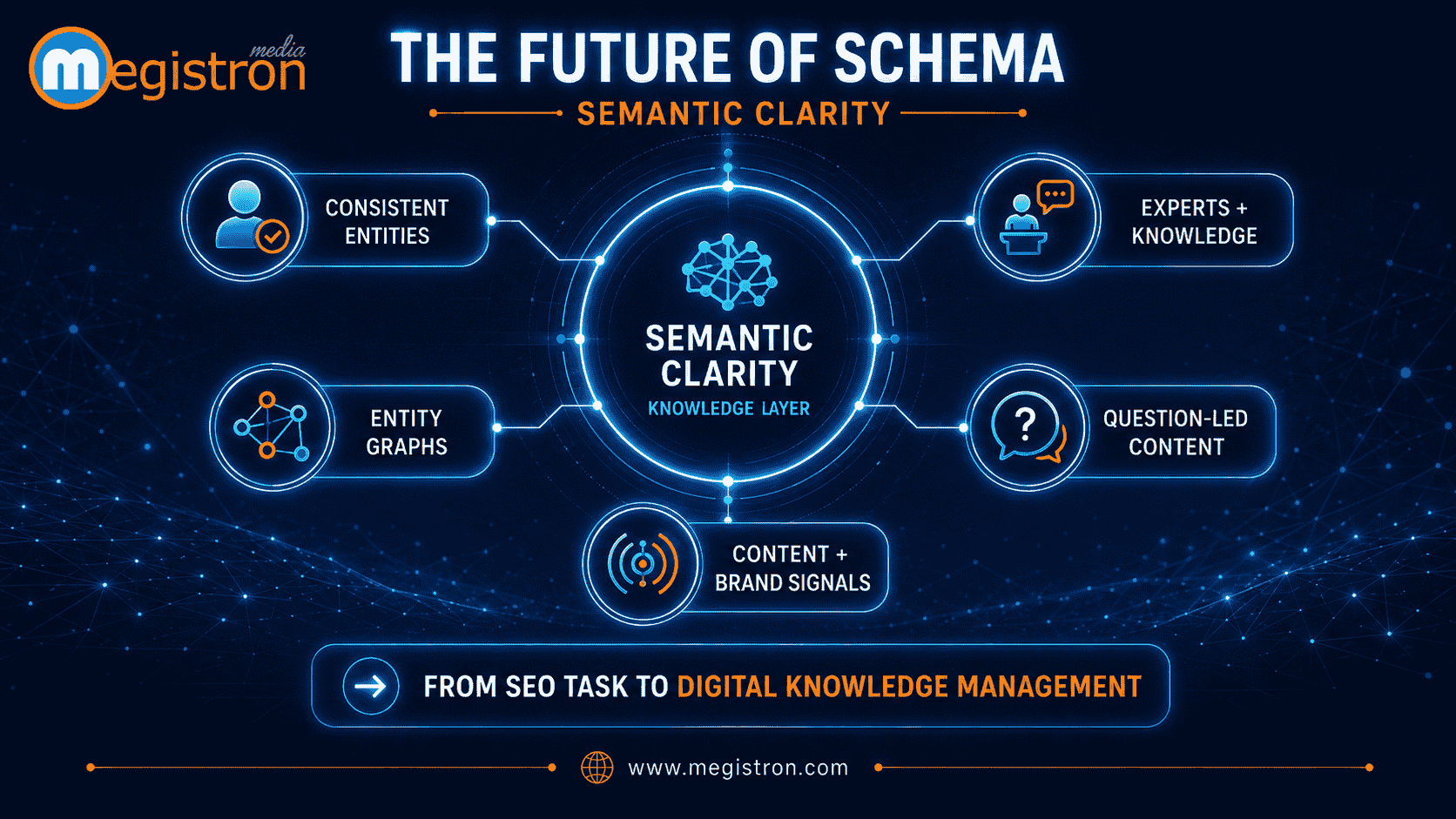
The future of schema markup is not in inventing some new “AI schema” types. Search engines possess developed vocabularies thanks to Schema.org. The competitive edge lies in the different ways of applying these vocabularies.
Businesses that gain success in AI search are the following:
- Have consistent presence as entities
- Have an ability to link speakers with their knowledge
- Have an ability to structure content in correspondence with the questions from users
- Have an ability to use entity graphs instead of separate schema blocks
- Experiment with synchronising structured data with perception of the content and signals coming from significant brands.
So schema moves from being an SEO work to becoming digital knowledge management.
Conclusion
In the era of AI search, schema is no longer just a technical aspect of SEO that is used to improve content after it was created. It became the tool that determines how the expertise, products, authors, and brand identity is shown in search dynamics.
The competitive advantage in the future will belong to businesses who do not add structured data, but create a digital knowledge structure of their organization. When schema markup reflects real-world relationships and supports valuable content, it helps to create stronger connections between your brand, users and AI search results.
The goal is not to add more schemas. The goal is to create more valuable signals for machines to understand and represent your information.
Frequently Asked Questions
Does schema markup guarantee inclusion in AI-generated answers?
No. Schema markup doesn’t guarantee the inclusion in Google AI Overviews, ChatGPT responses, Gemini summaries or other AI-generated search results. It improves the clarity and structure of your content, which could indirectly improve your citation potential.
Which schema types are most important for AI-search optimization?
The types of schemas that are greatly valued by businesses worldwide include Organization, Person, Article, Service, LocalBusiness, Product, and BreadcrumbList, as they assist in determining not only brand identity but also authorship and content purpose as well as commercial offerings and website structure.
What is the role of @graph for AI search?
@graph helps in identifying various related entities within a single JSON-LD structure that is related to each of those entities. It helps AI systems to understand how your organization, authors, services, products and articles are related to each other, creating more complex semantic networks than isolated schema blocks.
How often should schema markup be audited?
Schema markup needs to be audited every three to six months and right after the significant changes in website design, CMS, services, authors or business information.