

The best AI tools for SEO professionals are ChatGPT, Screaming Frog, Poppy AI, OpusClip, Runway, Midjourney, Ahrefs Brand Radar, Semrush AI Visibility Toolkit. But most SEO teams need just three or four tools that cover data, analysis, content creation, and performance measurement.
Introduction
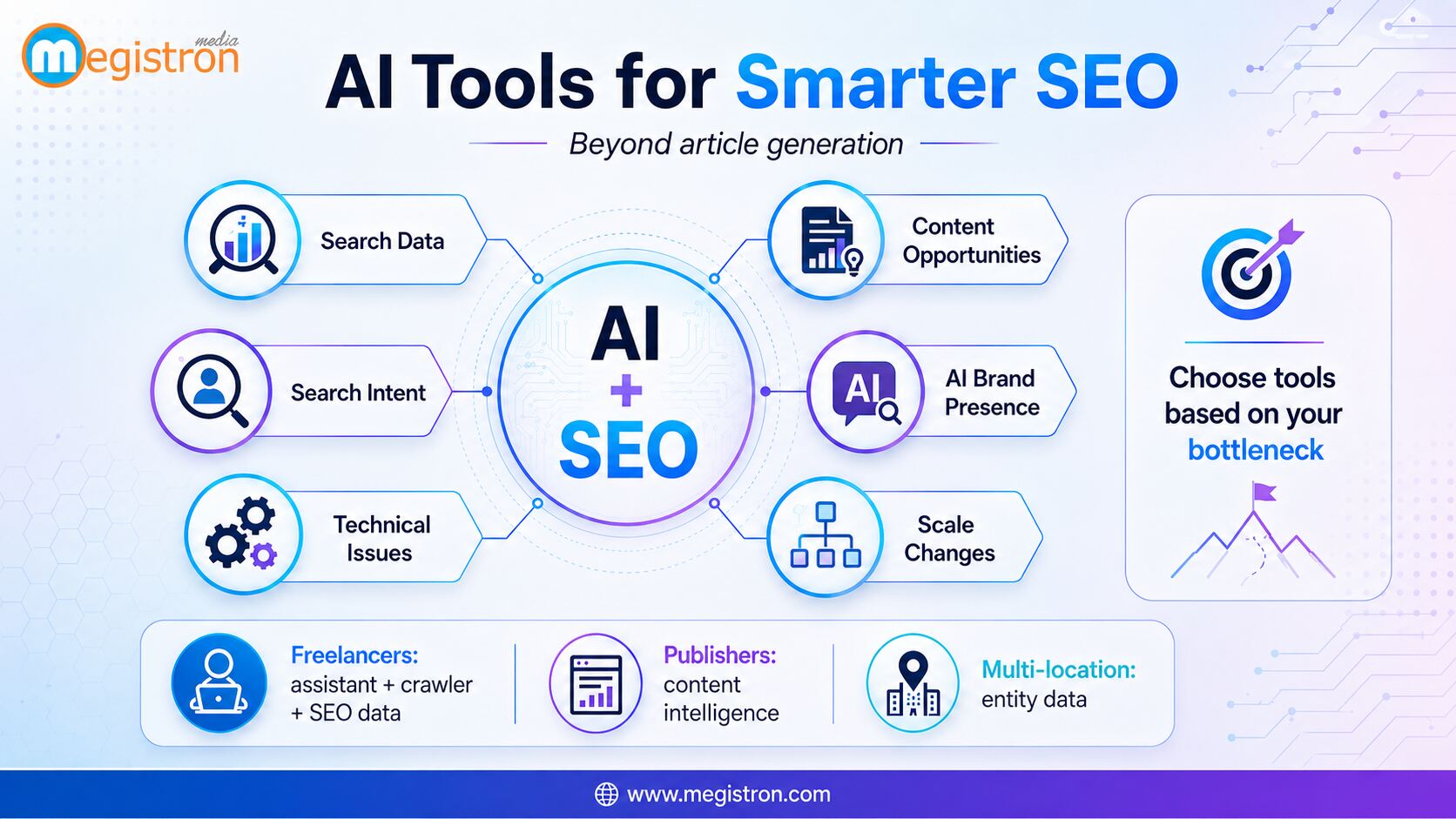
AI has revolutionized SEO, but its real power lies in mass-producing articles. Some of the best AI tools help SEO professionals to interpret search data, understand search intent, detect technical issues, prioritize content opportunities, monitor the brand presence in AI answers, and deploy changes at scale.
The wrong way to go is buying multiple platforms that offer similar keyword research, article creation, and optimization capabilities. The right way to go is finding the slowest or weakest link in your SEO process and choosing the platform that is built specifically to solve that issue.
An SEO specialist needs an AI assistant, a crawler, and one SEO database. A big publisher may need content intelligence and governance. A multi-location business can benefit from entity data more than from another writing platform.
In this guide, I will compare the top AI tools for SEO professionals by use case, cost level, ideal user, and practical limitations.
How These AI SEO Tools Were Evaluated
I have evaluated the AI tools according to five criteria: the quality of their data, the problem they solve, their ability to integrate with existing SEO workflows, the level of automation they offer, and the risk of making changes based on their recommendations without human review.
Instead of exact costs, I used the relative cost because subscription models change frequently. The tool recommendations are based on the capabilities described in product documentation and my workflow analysis. They are not built upon fake testing stories.
Best AI Tools for SEO Professionals ComparedTools TO Include
| Tool | Best for | Cost Level | Ideal User |
| ChatGPT | Research, analysis and automation | Low | Agencies and in-house teams |
| Screaming Frog | Technical and semantic audits | Low | Technical SEOs and agencies |
| Poppy AI | Content research and ideation | Moderate | Content marketers, creators and agencies |
| OpusClip | Video repurposing and short-form content | Low | Content marketers and social media teams |
| Runway | AI video generation and editing | Moderate | Creative teams, marketers and agencies |
| Midjourney | AI image and visual content creation | Moderate | Designers, marketers and content teams |
| Ahrefs Brand Radar | Broad AI visibility research | Premium | Competitive intelligence teams |
| Semrush AI Visibility Toolkit | Prompt monitoring | Premium | Agencies and established brands |
1. ChatGPT: Best for SEO Research and Analysis
ChatGPT works great with any verified SEO inputs: Search Console export, crawl data, keyword lists, content inventories, analytical files, and customer research. SEOs can use this platform to generate regular expressions, categorize the queries by intent, analyze title tag patterns, develop spreadsheet formulas, create schema markup for reviews, and prioritize technical issues.
ChatGPT supports web searches and works with files and allows users to get different levels of access depending on their paid plan.
The limitation of ChatGPT is its data. It should not generate ranking, traffic, backlink, and keyword metrics but interpret the existing one.
Best for: Integration with several SEO datasets and generation of decisions or deliverables.
2. Screaming Frog: Best for Technical and Semantic SEO Audits
Screaming Frog supports website crawling along with integrations with OpenAI, Gemini, Anthropic, and Ollama. Custom prompts can be executed against crawl data while vector embeddings can identify semantically similar pages and topical outliers. Also, the latest 2026 version of Screaming Frog introduces an MCP server that lets you execute and analyze crawls using natural language with supported AI assistants.
These capabilities are useful for content classification, mapping redirects, analyzing cannibalization, templating, and researching internal links.
But semantically similar pages are not necessarily duplicate. Rankings, conversions, links, and business logic matter. The free version of Screaming Frog is suitable for small crawls while advanced features require a paid license.
Best for: SEO professionals who need crawl data and AI-assisted classification in one place.
3. Poppy AI: Best for Visual Content Research and Ideation
Poppy AI provides a visual workspace where marketers can bring together different research materials and use AI to analyse them in one place. It can work with YouTube videos, podcasts, PDFs, voice notes and images, making it useful when research is spread across multiple formats. Users can also organise information through mind maps and boards instead of relying only on a traditional chat interface.
For SEO professionals, Poppy AI can help during topic research, competitor content analysis and early content planning. Teams can collect reference material around a subject, identify recurring ideas and turn research into briefs, article concepts or supporting content. Its newer content research features can also help analyse high-performing social content and creator activity.
However, Poppy AI should be treated as a research and content-development environment rather than a dedicated SEO platform. It does not replace keyword databases, rank tracking or technical crawling tools.
Best for: SEO and content teams that want to organise multimedia research and turn scattered information into content ideas.
4. OpusClip: Best for Repurposing Video Content
OpusClip is designed to transform longer videos into shorter clips that can be distributed across social platforms. Its AI can identify sections from long-form videos, create short clips, reframe footage for different screen formats and add elements such as captions, B-roll and audio enhancements.
This can support SEO and content strategies where video already plays an important role. A webinar, interview, podcast or educational video can be divided into smaller assets for YouTube Shorts, LinkedIn, Instagram and other channels. Instead of creating every short-form asset separately, teams can use existing long-form content as the starting point.
The tool is most valuable when a business already produces regular video content. It will have less impact for websites whose strategy depends almost entirely on written search content.
Best for: Content and SEO teams repurposing webinars, podcasts and long-form videos into short-form content.
5. Runway: Best for AI Video Creation and Editing
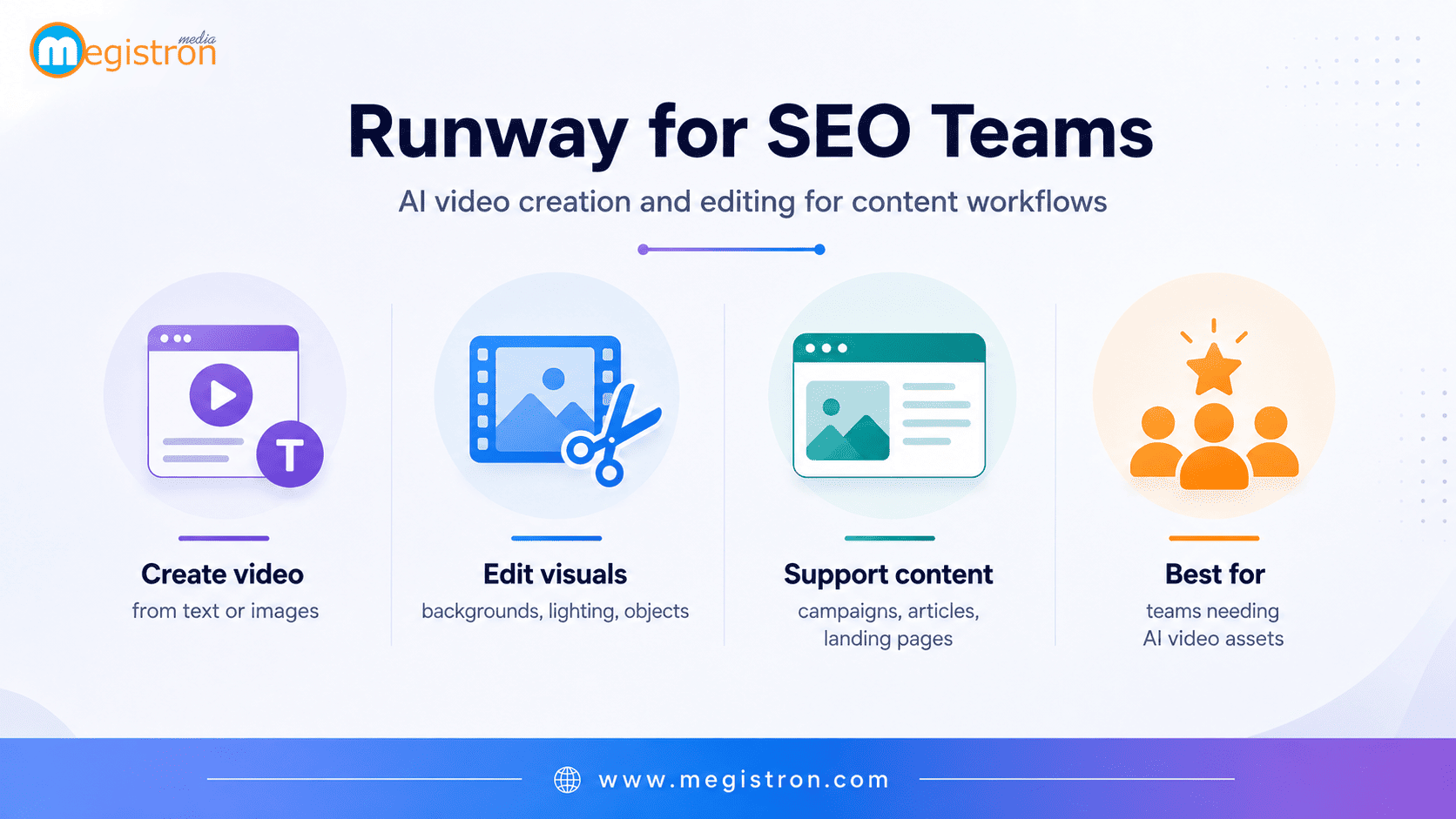
Runway provides generative AI tools for creating and editing visual content, with a strong focus on video. Its tools can generate video from text or images and modify existing footage by changing backgrounds, lighting, objects, environments and other visual elements. Runway also provides editing workflows for arranging and refining generated content.
For SEO professionals, Runway is particularly useful when a content strategy requires original video assets. It can support product explainers, campaign visuals, social content and supporting media for articles or landing pages without requiring every asset to begin with a traditional video production process.
Runway is not designed to determine what keywords to target or how a page should rank. The SEO strategy still needs to come first, with Runway primarily supporting the visual production stage.
Best for: Marketing teams that need AI-generated or edited video assets to support SEO, social and content campaigns.
6. Midjourney: Best for Creating Original Visual Content
Midjourney is a generative AI platform used to create images from prompts and visual references. Users can control aspects such as image style, composition and aspect ratio, while its web-based tools also allow existing creations and uploaded images to be modified. Its Editor supports functions such as changing selected areas, resizing compositions and extending images.
For SEO and content teams, Midjourney can help create supporting visuals for articles, landing pages, social posts and campaign concepts when suitable original imagery is not readily available. It can also be useful for developing visual themes and concepts before designers produce final branded assets.
AI-generated imagery still requires human review. Visual accuracy, brand consistency and suitability for the page should be checked rather than adding generated images simply to increase the amount of media on a page.
Best for: SEO, content and creative teams that need original visuals for articles, campaigns and digital content.
7. Ahrefs Brand Radar: Best for Broad AI Visibility Research
Ahrefs Brand Radar monitors brands’ visibility on a large base of AI-powered prompts. This platform evaluates AI mentions, citations, estimated impressions, and AI share of voice. Also, the tool allows users to identify frequently cited pages and compare competitors.
It is useful for discovering dominating brands on certain topics, sources influencing the AI answers, and whether a brand generates brand awareness without receiving any citation.
The scale is the advantage and limitation of this tool. Big prompt datasets can give you noise unless you segment the results by market, product, customer problems, and buying stage.
Best for: Competitive research and identification of patterns in AI-generated answers.
8. Semrush AI Visibility Toolkit: Best for Prompt Tracking
Semrush is more efficient when a business already knows the important prompts. The AI Visibility Toolkit offers the following features: competitor analysis, sentiment research, prompt discovery, site auditing, and daily monitoring for selected prompts. The tool covers ChatGPT, Google AI Mode, and Gemini.
Currently, the AI Visibility Toolkit is available separately and includes limits for prompts tracked, domains, audits, and exports. Additional capacity will increase the total cost.
There is no single permanent “AI ranking.” The results can differ by platform, prompt wording, location, and date. Tracking of the controlled prompt set will give you reliable trends analysis rather than occasional checks.
Best for: Ongoing tracking of high-value commercial prompts.
Which AI SEO Stack Should You Choose?
Most SEO teams do not need ten subscriptions. The minimal stack that is sufficient for the job includes ChatGPT for analysis, Screaming Frog for crawling, and either Ahrefs or Semrush for established SEO data and visibility monitoring.
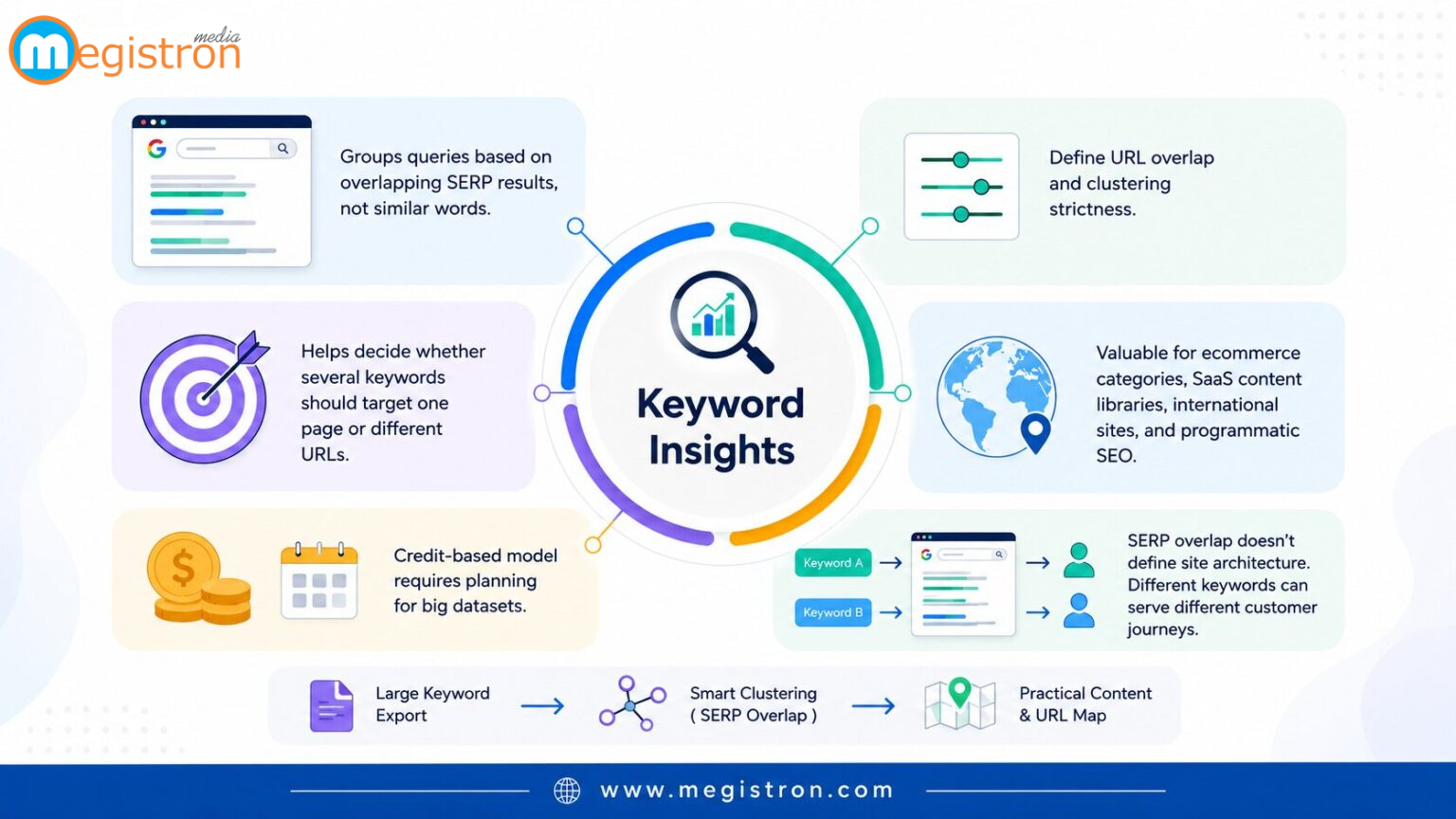
For the companies focused on the content, Keyword Insights could be added when URL mapping becomes difficult. Surfer could be used when page optimization is needed often, while MarketMuse makes more sense in case of a large content inventory requiring strategic prioritization.
Yext, Alli AI, and Conductor should be acquired when scale brings a particular issue. Multi-location data, implementation delays, and cross-team governance are valid reasons for investment. Not the feature list, however.
A Practical AI SEO Workflow
Imagine a SaaS company with 5,000 Search Console queries and hundreds of existing articles. ChatGPT could clean up the export and classify queries by topic, intent, and sales funnel stage. Then, Keyword Insights could group remaining keywords according to SERP similarity.
MarketMuse could identify clusters corresponding with the site’s topical authority. Surfer could optimize selected pages while Screaming Frog would check for indexability, semantic overlap, internal links, and implementation quality.
Lastly, Ahrefs Brand Radar could reveal the bigger picture of AI visibility. And Semrush would monitor a smaller set of commercial prompts over time.
This workflow does not guarantee ranking. As usual, results depend on the authority, competition, technical quality, differentiation, customer value, and execution.
Common AI SEO Mistakes
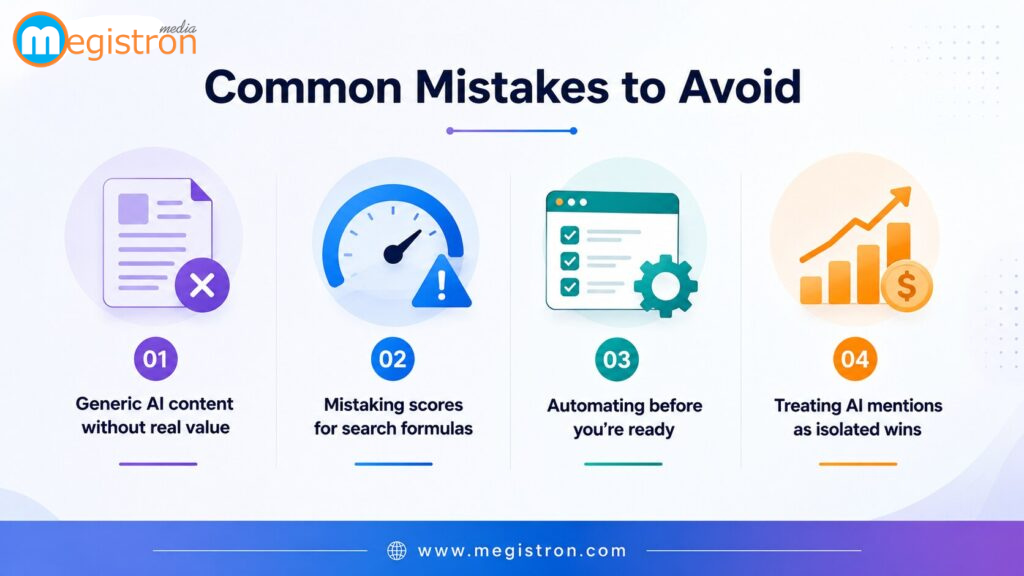
The first common mistake is the publication of generic AI content without original evidence, experience, examples, and even expert review. Accelerated production is not a competitive advantage when every competitor is able to create such text.
Secondly, proprietary scores should not be considered formulas of search engines. Content scores, keyword difficulty, and AI visibility are simplified representations of complex signals. They should assist in decision-making, not substitute it.
The next mistake is the automation before it is ready. Before launching the changes on the large scale, you need approval rules, test groups, monitoring, version history, and rollbacks.
Finally, AI mentions should not be presented as an isolated success. The visibility becomes commercially meaningful only when it influences qualified demand, branded searches, assisted conversions, leads, and revenues.
Key Takeaways
The best AI tools for SEO professionals solve different problems. ChatGPT accelerates analysis, Screaming Frog improves auditing, Keyword Insights maps intents, MarketMuse assists in strategic planning, and Surfer optimizes pages.
Ahrefs and Semrush measure AI visibility in their own way. Yext, Alli AI, and Conductor are valuable when local data, implementation or enterprise governance causes a bottleneck.
The best stack is always smaller than one might expect. Reliable data, clear workflow, and human review mean more than purchased tools.
Conclusion
The top AI tools for SEO professionals are not just article generators. Their real value is in accelerating research, search-intent mapping, technical analysis, content prioritization, implementation, and visibility measurement.
Always start from a business constraint, not the software. Select tools that offer reliable evidence, fit into workflow and reduce a bottleneck. Leave the responsibility for accuracy, strategy, and approvals to the human beings.
Used in this way, AI becomes more than just a shortcut. It becomes an operating system for modern SEO.