
SEO is changing at an incredible pace. In addition to ranking on a list of blue links, users are starting to expect AI-driven responses to their questions from search engines like Google AI Overviews, ChatGPT, Perplexity, and Gemini.
While the former works with a set of web pages, the latter generates responses based on selected, summarized, and cited trustworthy sources.
Thus, the emergence of AI search brings a whole new problem for content marketers and SEO specialists:
How do you create content that AI search engines actually cite?
The solution isn’t about ignoring the basics of SEO. Instead, you should evolve your SEO strategy to produce trustworthy, clear content that is optimized for search engines.
Here is what AI-citable content is all about and how you can create an AI-friendly content strategy.
Benefits of AI Citations
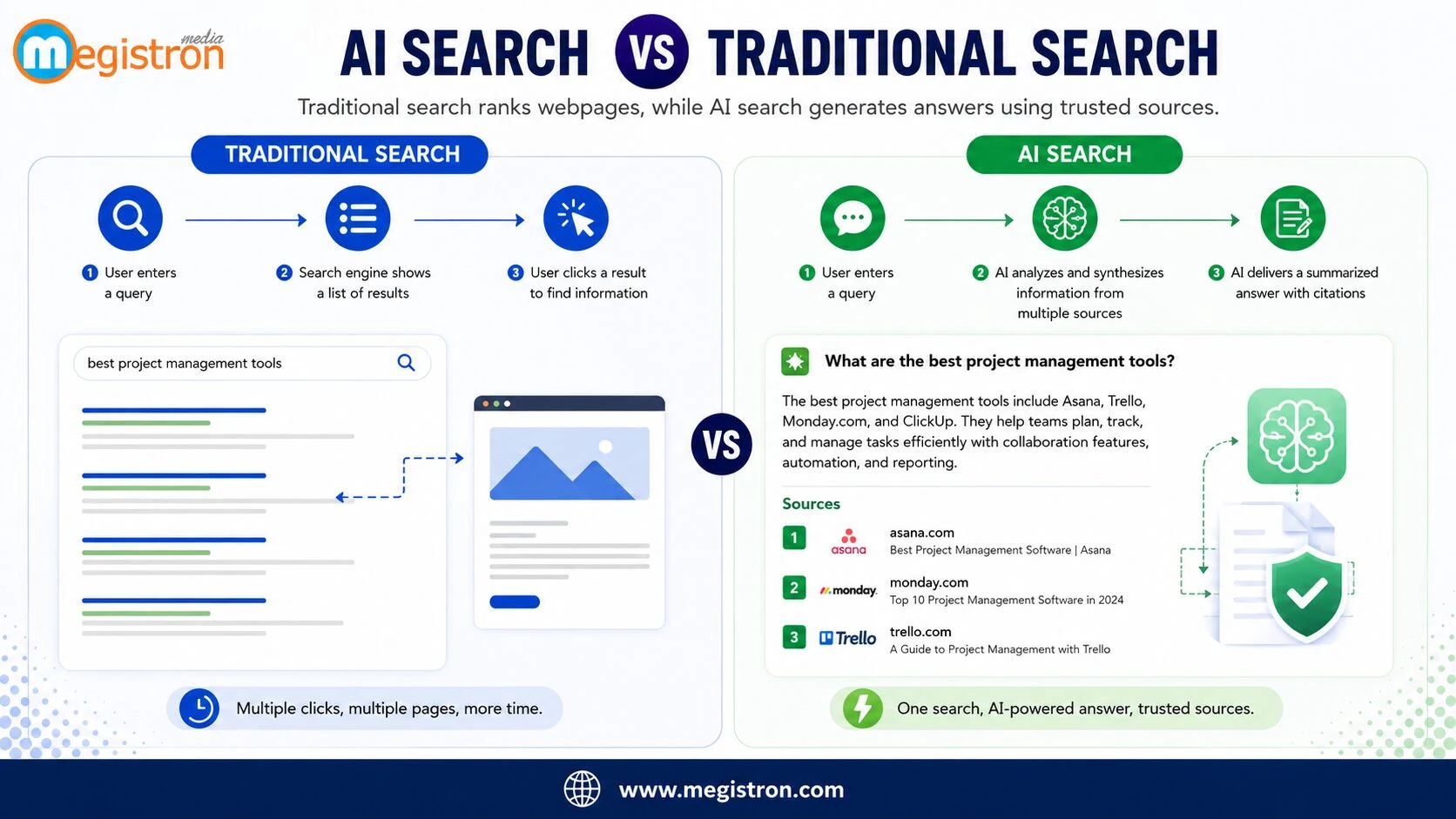
The moment you get cited by AI search engines, you are listed in the references of an answer to a question.
This way, your content can bring you several benefits:
- Build brand authority and credibility
- Increase visibility even if users don’t click on traditional search results
- Generate quality referral traffic
- Establish topical authority in the niche
- Future-proof your SEO strategy against changes in AI-driven search
Unlike traditional search engine rankings, AI search engines prioritize clarity, trustworthiness, expertise, and extractable information over keyword density. According to recent industry research, AI systems also increasingly favor content with demonstrated expertise and verifiable information.
AI Search Isn’t Human
SEO used to focus primarily on understanding the content by Google.
AI search takes it even further: it tries to understand the content and extract the answer to a user’s question from the content.
Instead of scanning an article from start to finish, AI search engines are likely to extract the paragraphs, lists, tables, and definitions that provide an answer to a question.
Therefore, your content needs to be structured in a way that lets individual paragraphs stand on their own.
For example, instead of writing:
“Before we discuss local SEO, we first need to understand the history of search engines…”
It’s better to write:
“Local SEO is the process of optimizing your online presence to appear in local search results for nearby customers.”
The second piece of text immediately provides the answer, which makes it much easier for AI to extract.
Begin with User Questions, Not Only with Keywords
Keyword research is definitely important, but modern content should be built on the basis of user questions rather than on keywords alone.
Users tend to ask questions conversationally:
- How do AI search engines pick sources?
- What content should be considered trustworthy?
- Why isn’t my website cited in ChatGPT?
Such intent-driven questions allow you to better understand what users are looking for and create an article that answers the question.
Instead of creating one big article with dozens of keywords, you should create separate articles with a set of questions answered.
This practice is helpful in improving readability as well as in making your content easier for AI extraction.
Place the Answer in the Beginning
Perhaps one of the major differences between traditional blog post writing and AI-citable content is the location of the answer.
Articles written for traditional SEO usually provide several paragraphs of introduction before providing the answer to the question.
AI search engines, however, prefer the opposite.
Each section needs to have the answer at the very beginning, followed by several supporting details.
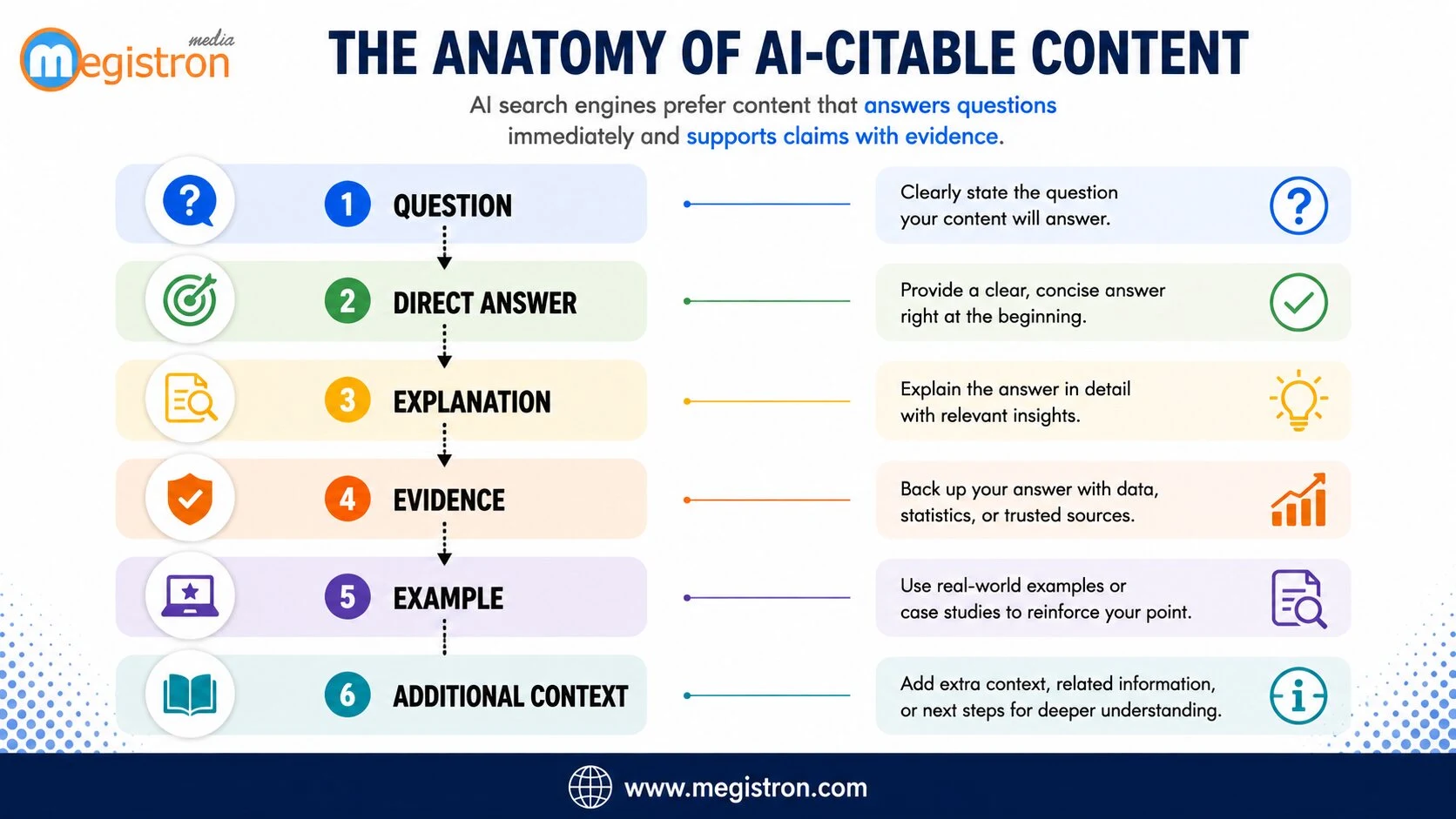
A good structure of such a section is the following:
- Direct answer
- Explanation
- Supporting evidence
- Example
- Additional context
The above-mentioned structure is beneficial not only for readers but also for AI systems, as they find it easier to comprehend the most important information from the start.
Gain Credibility with Actual Expertise
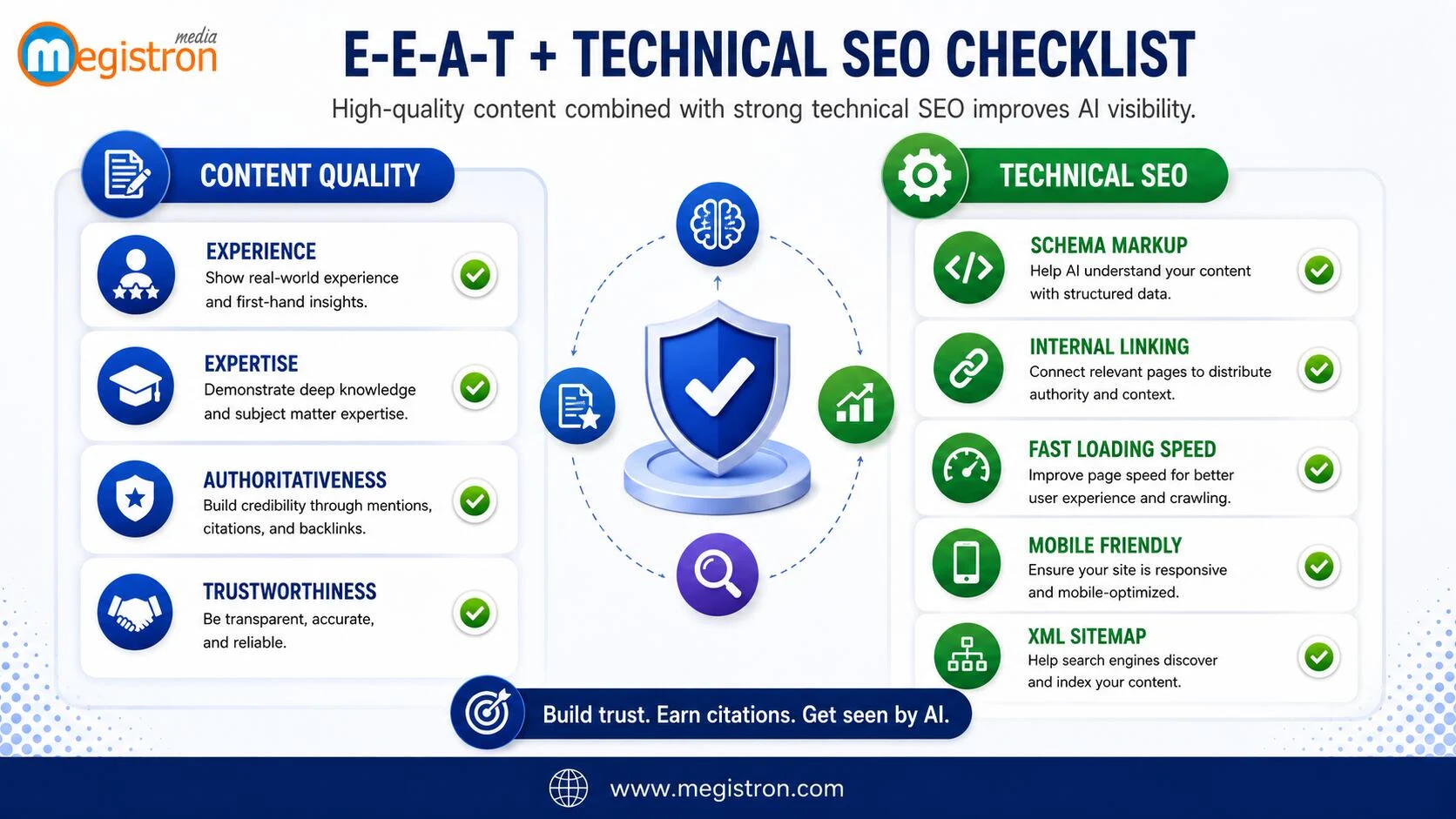
AI search engines prefer to cite the content created by actual experts.
This principle corresponds to Google’s E-E-A-T principle:
- Experience
- Expertise
- Authoritativeness
- Trustworthiness
Your article should prove why your knowledge deserves to be trusted.
You can do it with the following elements in your articles:
- Real-life examples
- First-hand experience
- Case studies
- Original insights
- Expert quotes
- Industry statistics
- Author bio
The more clearly AI detects the expertise in your article, the higher the chances are that it will cite it in answers.
Back Up Every Statement with Credible Sources
Another powerful way to increase the credibility of your content is to back up your statements with credible sources.
Instead of stating that:
“Most businesses benefit from local SEO.”
You should say:
“Businesses with optimized local profiles experience increased visibility in nearby search results.”
Whenever possible, you should add the following:
- Government data
- Industry research
- Academic studies
- Reliable reports
- Original company data
Numbers are generally more useful than general statements, as AI models can easily reference such information.
Make Every Section Independent
Imagine that you copy and paste the content of one of the sections of your article into ChatGPT.
Does it make sense?
Very often, AI extracts separate sections of the content, not full articles.
Good standalone sections contain the following information:
- A clear heading
- A direct answer to the question
- Supporting explanation
- Relevant context
Try not to create sections that require an understanding of previous paragraphs in order to be understandable.
Such an approach not only improves readability but also extractability.
Format Your Content Properly
Properly formatted content is easier to read for both humans and machines.
Here are some examples of basic content formatting improvements:
- Descriptive H2 and H3 headings
- Short paragraphs
- Lists (unordered and ordered)
- Comparisons (tables)
- Key takeaways
- FAQs
You should not create walls of text. Instead, you should format your information into digestible chunks.
This structure helps AI quickly find definitions, processes, comparisons, and recommendations.
Provide Unique Information in Your Content
AI search engines need unique information rather than just another generic article.
Examples of the information that would be highly appreciated by AI are the following:
- Original research
- Results of surveys
- Customer case studies
- Industry benchmarks
- Unique frameworks
- Practical templates
- Experiments and personal testing
Unique information allows AI to add something truly new to its answer rather than reference something that was said somewhere else.
Just one piece of original information can make your article more credible.
Update Your Content Regularly
AI search engines might favor more recent articles, especially those from rapidly developing niches.
Content updating should become an integral part of your SEO strategy.
Regular updates might consist of the following items:
- New statistics
- Updated screenshots
- New examples
- Latest industry news
- Updated best practices
- Revised recommendations
Any kind of content updating will increase the credibility of your article compared to a simple change of publication date.
Improve Technical SEO
Technical SEO remains important for being visible to AI search engines.
If your website is hard to crawl and comprehend for search engines, it’s also hard for AI to extract any valuable information.
Here are some technical elements that you should pay attention to:
- Page loading speed
- Mobile-friendliness of your website
- Heading hierarchy
- Internal linking
- Descriptive URL structures
- Schema markup
- XML sitemaps
Structured data, such as Article, FAQ, Organization, and Author schema, provides additional context for search engines to understand your content.
Build Your Authority Off-site
AI search engines don’t need to reference your website alone.
They can also consider information that is available elsewhere on the web.
Therefore, building your authority involves content creation, among other elements.
Some off-site SEO practices that might increase your authority are:
- Guest posts
- Digital PR
- Interviews
- LinkedIn articles
- Podcast appearances
- Community engagement
- Quality backlinks
By appearing consistently as an expert on trusted platforms, you can reinforce your authority and earn citations.
Write for Human Beings
Ironically, the best AI-citable content is the most human content.
You shouldn’t try to write specifically for algorithms. Instead, you need to clearly and accurately solve the problems of your audience.
Ask yourself the following questions:
- Does this article answer the reader’s question immediately?
- Are all statements backed up with credible sources?
- Can an expert confirm that this advice is true?
- Is the article easy to scan?
- Is there anything unique in the article?
If the answers are positive, you’ve already done a lot to create AI-citable content.
Common Mistakes That Prevent AI Citations
Many websites publish content following outdated SEO techniques.
Among the major mistakes are the following:
- Writing long introductions before answering the question
- Publishing generic AI-written content with no original ideas
- Making vague statements without supporting evidence
- Ignoring the expertise of the authors
- Creating blocks of text without proper formatting
- Focusing on keywords while ignoring user intent
- Letting important content become outdated
Avoiding these mistakes can greatly increase your chances of becoming a cited source.
Future of AI Search
The evolution of AI search doesn’t mean that traditional SEO is disappearing. Instead, SEO is evolving.
Ranking in traditional search results is still valuable, but visibility is increasingly influenced by whether AI systems consider your content trustworthy enough to reference.
The websites that succeed will be those that combine strong SEO fundamentals with clear writing, structured formatting, demonstrated expertise, and genuinely helpful information.
Content creators who embrace this shift today will be better prepared as AI-powered search becomes an even larger part of how users discover information online.
Final Thoughts
Building AI-citable content isn’t about discovering a secret optimization technique. It’s about creating content that is accurate, authoritative, easy to understand, and genuinely useful.
Start by answering real user questions, place the answer first, support your claims with credible evidence, structure every section clearly, and demonstrate authentic expertise. Combine these practices with strong technical SEO and regular content updates to create content that serves both readers and AI search engines.
As AI continues to reshape the search landscape, the brands that succeed won’t simply rank—they’ll become trusted sources of information. When your content consistently delivers clear, credible, and valuable answers, it stands a much better chance of earning the AI citations that drive visibility, authority, and long-term organic growth.
Frequently Asked Questions (FAQs)
What does it mean for AI search engines to cite your content?
When AI search engines cite your content, they use your website as a source when generating answers for users. Platforms like Google AI Overviews, ChatGPT, Perplexity, and Gemini often reference authoritative websites to support the information they provide. Being cited helps increase your brand’s visibility, credibility, and potential referral traffic.
How can I make my content more likely to be cited by AI?
To improve your chances of being cited, create high-quality content that answers user questions clearly, demonstrates expertise, includes credible sources, uses descriptive headings, and is easy to scan. Adding original research, case studies, and well-structured FAQs can also increase the likelihood of AI systems referencing your content.
Is traditional SEO still important for AI search?
Yes. Traditional SEO remains the foundation of online visibility. Technical SEO, keyword research, page speed, internal linking, mobile optimization, and structured data all help search engines discover and understand your content. AI search builds on these fundamentals by prioritizing content that is trustworthy, well-organized, and genuinely helpful.
What type of content do AI search engines prefer?
AI search engines tend to favor content that provides direct answers, covers topics comprehensively, includes factual evidence, demonstrates expertise, and is easy to extract into summaries. Content with clear headings, concise paragraphs, bullet points, tables, and FAQs is generally easier for AI systems to interpret.
Does using AI to write content reduce my chances of being cited?
Not necessarily. AI can be a useful tool for drafting content, but articles should always be reviewed, edited, and enhanced by human experts. Adding original insights, real-world examples, expert opinions, and accurate data helps create content that stands out and earns trust from both readers and AI search engines.